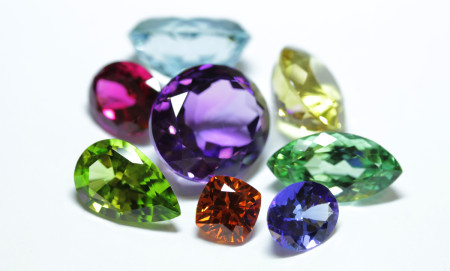
Precious stones
- Diamond: mineral composed of carbon. The hardest natural material (10 on the Mohs scale).
- Emerald: mineral from the silicate group with traces of chromium, vanadium and sometimes iron. Gemstone from the Beryl family.
- Ruby: gemstone from the corundum family with the presence of chromium oxide (9 on the Mohs scale).
- Sapphire: gemstone from the corundum family (9 on the Mohs scale).
Semi-precious stones
- Agate: variety of chalcedony
- Aquamarine: mineral from the silicate group, variety of beryl
- Amethyst: mineral of the violet quartz variety with traces of iron
- Aventurine: mineral of the quartz variety containing inclusions of fuchsite, hematite or mica
- Chalcedony: mineral from the silicate group, considered a mixture of quartz and moganite
- Citrine: yellow to orange quartz
- Garnet: group of silicate minerals with different varieties
- Jade: generic term for jadeite and nephrite
- Lapis lazuli: metamorphic rock mainly containing lazurite
- Malachite: copper carbonate with characteristic green bands
- Opal: hydrated silica with unique color plays
- Peridot: variety of olivine of olive green color
- Rose quartz: quartz colored by titanium or manganese inclusions
- Tanzanite: blue-violet variety of zoisite
- Topaz: aluminum and fluorine silicate (8 on the Mohs scale)
- Tourmaline: group of complex minerals offering a wide range of colors
- Turquoise: hydrated aluminum and copper phosphate
- Zircon: zirconium silicate
Important distinction
The distinction between precious and semi-precious stones is mainly historical and cultural. Many semi-precious stones can be as rare and valuable as the four stones traditionally classified as "precious". The value of a gemstone depends on its quality, rarity, size and origin.